Admissions open for 2026-2027
Counselling Code : 1503





Arulmigu Meenakshi Amman College of Engineering (AMACE) offers a B.E. Civil Engineering program designed to develop practical and industry-ready skills in structural engineering, construction, infrastructure, transportation, environmental engineering and related fields.
Admissions are now open for the B.E Civil Engineering program at Arulmigu Meenakshi Amman College of Engineering.
Start your engineering journey with industry-oriented education, practical learning, and strong career opportunities in construction and infrastructure sectors.
The Department of Civil Engineering was established in 1985 and offering B.E. Civil Engineering program with an intake of 60 Students and M.E. Structural Engineering Program was introduced in 2010 with an intake of 18 Students. The Department has qualified faculty members with excellent academic records to promote technical knowledge in the areas of Structural Engineering, Construction Management, Infrastructure Engineering, Architectureand research. The Department is equipped with excellent laboratory facilities and creates world class engineers with professional knowledge through advanced teaching learning methods for the benefit of Academic, R&D and Consultancy activities. The Department has signed MoUs with many leading industries and consultancy is offered to Government and Private Organizations and the department undertakes a wide range of consultancy services on Analysis and Design of Multi-story Buildings, Testing of Building Materials, Quality Analysis of Water Samples and Test on Soil samples. Our Students are educated with real life examples and design to build a clean environment.
| Programme of Study | Description |
|---|---|
| B.E. Civil Engineering |
Started with 60 seats in 1985. Vide Ref: F.No:45-19/91 AICTE/5571 dt:
17.02.1992. Accredited by NBA-AICTE in 2004 for 3 years F. No: NBA/ACCR-375/2004, Date: 17.06.2004 Accredited by NBA-AICTE in 2008 for 3 years F. No: NBA/ACCR-375/2004, Date: 19.07.2008 |
The B.E Civil Engineering program at Arulmigu Meenakshi Amman College focuses on infrastructure development, structural engineering, construction technology, environmental engineering, and sustainable development practices.The Department of Civil Engineering at Amace is committed to developing skilled civil engineers equipped with technical expertise, practical knowledge, and industry-oriented learning. Established in 1985, the department has consistently delivered quality engineering education through advanced teaching methodologies, experienced faculty members, modern laboratories, and industry-integrated learning.
The B.E Civil Engineering program offers excellent career opportunities in construction, infrastructure, urban planning, transportation, and government engineering sectors.
The department focuses on preparing students with practical engineering skills required for modern infrastructure industries
"We envision a department where technological resources will initiate promote and sustain the core elements of this vision. Nurturing emerging disciplines and the creation of new knowledge and artistic expression in response to a rapidly changing world."
B.E Civil Engineering is one of the core engineering disciplines that focuses on the planning, design, construction, and maintenance of infrastructure and public works related to earth, water, transportation, and urban development. Civil Engineering plays a major role in shaping modern society through the development of roads, bridges, buildings, railways, water supply systems, irrigation projects, flood control systems, transportation networks, and environmental infrastructure.
The Department of Civil Engineering equips students with the technical expertise required to contribute to sustainable infrastructure development and smart engineering solutions. The Department has well-equipped laboratories with necessary computer systems, software, and equipment. Each laboratory has adequate space as per AICTE norms and meets all requirements prescribed by Anna University, and is supervised by experienced faculty members.


A basic knowledge of
Fluid Mechanics is essential for all civil engineers as they frequently come across a variety
of problems involving flow of fluids, force of fluid on structural surfaces, etc. This
laboratory is used for experimentation on the properties and behavior of fluids.
The area of the lab is 308 sq.m.

The Soil Mechanics Lab
provides academic and research services through performing all lab tests needed for analysis
and study of soil characteristics and its properties.
The area of the lab is
203 sq.m.


Concrete is the most
widely used construction material. The concrete laboratory tests every component in the
concrete mix design as well as the concrete mix itself, evaluating both plastic and hardened
properties.
The Highway Engineering lab consists of equipment used in the testing of
bituminous materials such as viscosity, ductility, and plasticity, along with devices for
super-pave testing of bitumen and aggregates, and mix design by both Superpave and Marshall
Methods.
The area of the lab is 206 sq.m.


The Environmental Lab
comprises modern and technically advanced instruments needed for water and wastewater
analyses. The lab also has many in-situ devices and equipment to perform different types of
measurements and to take grab and composite water and wastewater samples.
The area of the lab is 187 sq.m.
The CAD Lab is equipped
with AutoCAD software and is extensively used for design and drawing. The knowledge gained in
the lab equips students to provide quality service once employed in the industry.
The area of the lab is 288 sq.m.
The Survey Lab is used
for surveying exercises and is equipped with the latest instrumentation, including levels,
total stations, and GPS receiver sets, for conducting ground surveying works.
The
area of the lab is 588 sq.m.


This lab is equipped
with major equipment such as a Universal Testing Machine, Torsion Testing Machine, Beam
Testing Apparatus, Rockwell Hardness Testing Machine, Brinell Hardness Testing Machine, Impact
Testing Machine, and Muffle Furnace, along with minor equipment such as metallurgical
microscopes, Vicat apparatus, Le-Chatelier mould, and Le-Chatelier flask. Students gain
practical knowledge through this equipment with the help of lab manuals, and various tests
related to mechanical properties are conducted here. This lab is utilized by both civil and
mechanical engineering students.
The area of the lab is 198 sq.m.

The Advanced Structural
Engineering Laboratory is equipped with a loading frame of 100T capacity for both horizontal
and vertical loading, a Rebound Hammer, an Ultrasonic Pulse Velocity Tester, hydraulic jacks
(10T, 20T, 30T), load cells (7.5T, 15T, 30T) with indicator, a proving ring, strain indicator,
hydraulic crane (2T), and a vibration meter and exciter of 5N capacity. Structural analysis
experiments help students understand the practical behaviour of physical structures such as
beams, slabs, and columns, and solve practical structural problems.
The area of
the lab is 308 sq.m.


The Department of Civil Engineering equips students with the technical expertise required to contribute to sustainable infrastructure development and smart engineering solutions.Civil Engineering professionals are responsible for creating safe, functional, and efficient structures that improve the quality of life and support economic growth.
To apply fundamental technical knowledge and skills to find creative solutions to technological challenges and problems in various areas of basic science and engineering.
To take up higher education & to engage in research and development in civil engineering and allied areas of science and technology.
To prepare graduates to deal with ethical and professional issues, taking into account the broader societal implications of civil engineering.
Use technical, teamwork, and communication skills, along with leadership principles, to pursue civil engineering careers in areas such as structural, transportation, geotechnical, materials, environmental, construction, and water resources engineering or other fields.
Our department is equipped with the latest infrastructure and imparts technical education to students. Research activities are carried out with sophisticated equipment enabling frontier-area research.
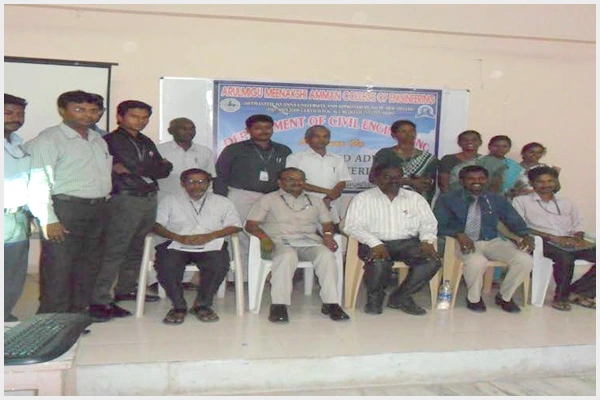
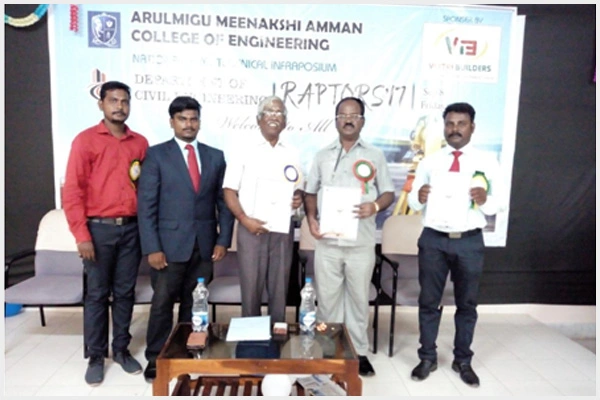
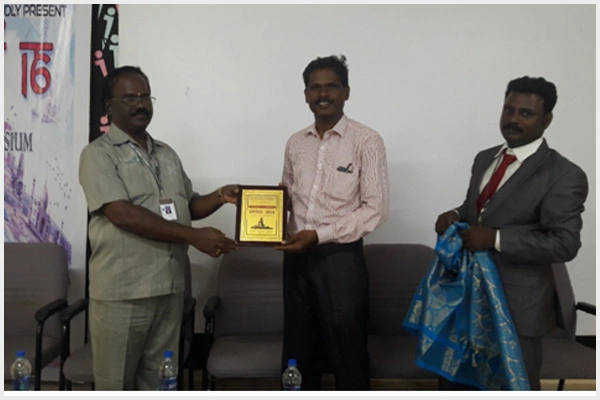
A Special Lecture on Recent trends and advances in Civil Engineering organized by the Department of Civil Engineering. Dr.V.Jothi Prakash, Associate professor, Department of Civil Engineering IIT Mumbai, Dr.C.Jagadeesan, Principal Dr.G.Sundar, vice principal presided over the function
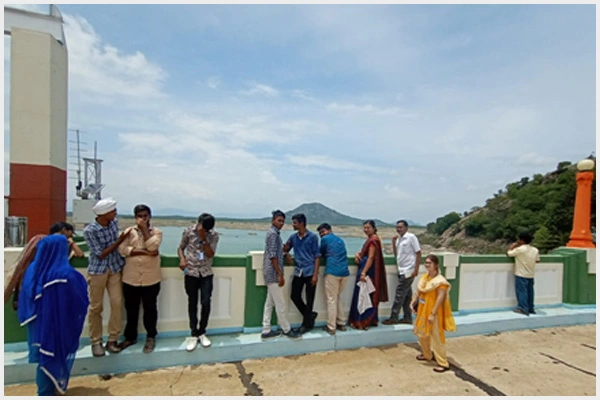
Sathanur dam, ponnaiyur, Tiruvannamalai, To learn the construction details, water distribution, irrigation structures and working of gallery.
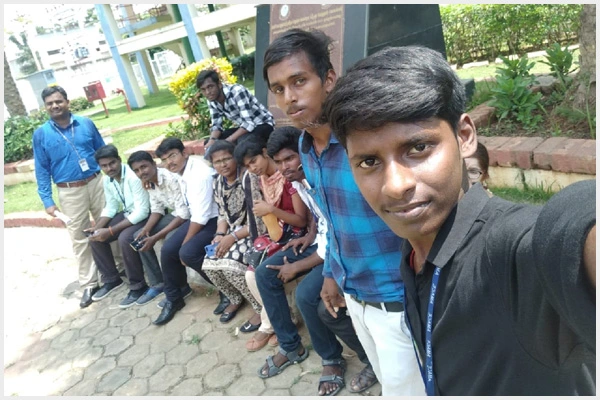
One day workshop on how to complete Ph.d, Higher Education Academy, London
| S.No | Name | Designation | FIN | AICTE ID |
|---|---|---|---|---|
| 1 | Dr. HARIPRABA R | Associate Professor | 2619981984 | 1-3378309403 |
| 2 | Mr BALASARAN SANKAR | Assistant Professor | 2630912001 | 1-44923587757 |
| 3 | Mr KALAIYARASAN V | Assistant Professor | 2641801992 | 1-9321315011 |
| 4 | Mr THIRUMAL K | Assistant Professor | 2665942000 | 1-47152315583 |
| 5 | Mr SENTHIL KUMAR T V | Assistant Professor | 2674591985 |
Graduates of B.E Civil Engineering at AMACE can work as Civil Engineers, Structural Engineers, Site Engineers, Construction Engineers, Transportation Engineers, and Infrastructure Planning Engineers.
AMACE offers advanced laboratories, experienced faculty, practical exposure, internship opportunities, placement support, and industry-oriented Civil Engineering education.
Yes. The department provides aptitude training, technical interview preparation, communication skill development, and campus recruitment support.
Graduates are hired by construction companies, infrastructure firms, government organizations, transportation departments, real estate companies, and engineering consultancy firms.
